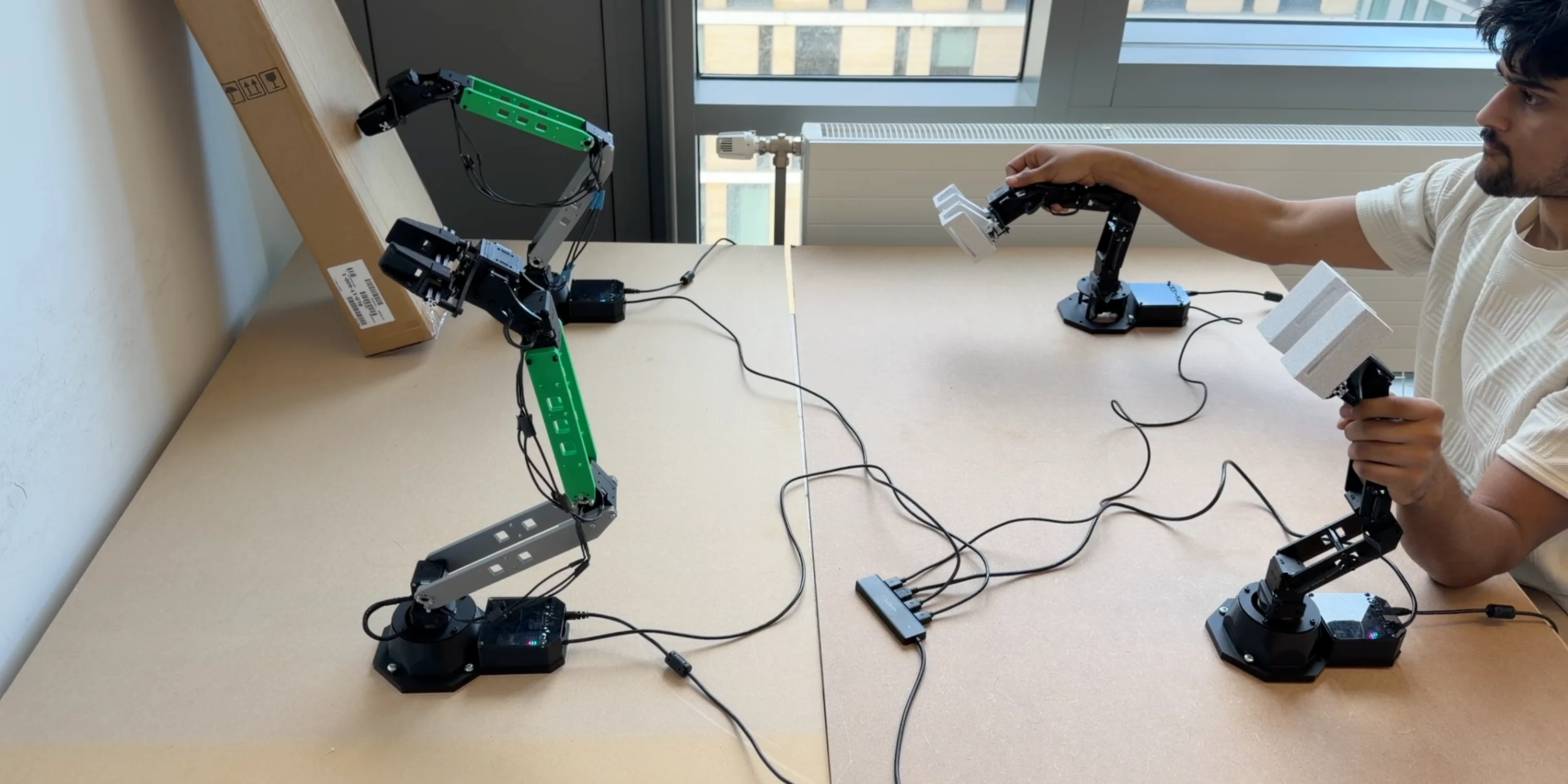
Custom Scaled Hardware
Rather than purchasing larger commercial arms, we designed and 3D-printed custom follower arms at 2× scale. The original PincherX-100 STL files were decomposed into motor mounts (kept at original scale) and arm segments (scaled 2×), because naive uniform scaling would enlarge motor cavities beyond the physical motor dimensions.
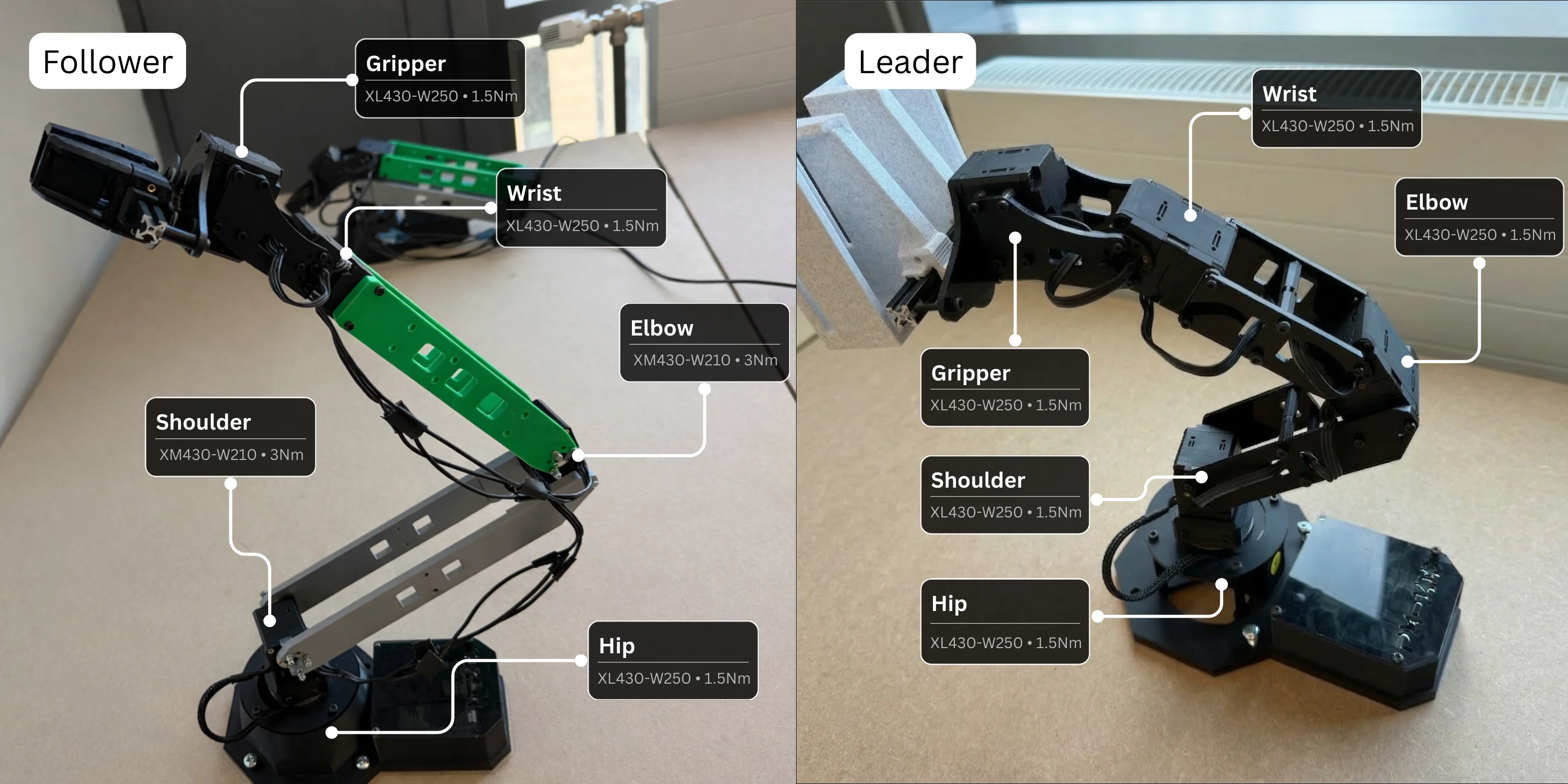
Standard PincherX-100 leader arm alongside the custom 2x-scaled follower with annotated motor positions
We use a torque-tiered motor design: high-torque XM430-W210 motors ($333 each, 3.0 Nm) at the shoulder and elbow where 2× scaling demands 4× the torque, and commodity XL430-W250 motors ($27.50 each, 1.5 Nm) at the waist, wrist, and gripper. This saves 55% on follower motor cost versus a uniform high-torque design.
Sensorless Force Feedback
The core contribution: bilateral force feedback using only motor current readings from standard Dynamixel servos. No force/torque sensors, no strain gauges, no additional hardware. The follower's motor effort (in mA) is read at 100 Hz. When effort on any joint exceeds a 300 mA threshold, proportional PWM resistance is applied to the corresponding leader joint, letting the operator feel what the follower feels.
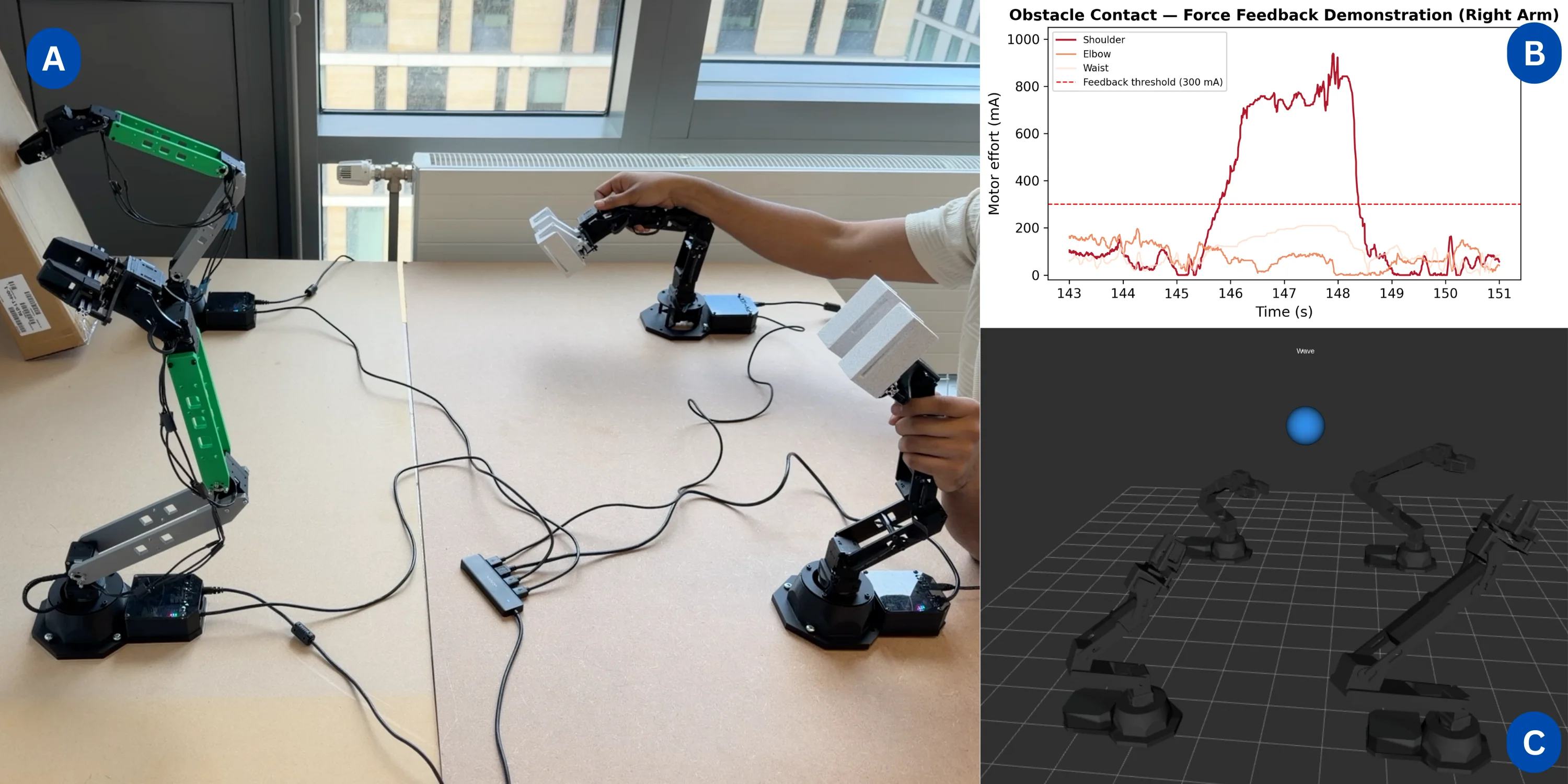
Multi-panel figure: (A) operator with leader arm contacting obstacle, (B) effort graph showing contact spike, (C) RViz visualization
The Gravity Problem
We identify a fundamental limitation: motor current conflates gravitational torque, contact forces, friction, and electromagnetic braking into a single signal. When the arm is extended horizontally, gravity alone produces 400–600 mA at the shoulder—indistinguishable from obstacle contact. We tested four heuristic approaches (velocity gating, position error detection, follower velocity thresholding, and the proportional method we deployed). All fail under gravity, for different instructive reasons.
This establishes a necessary condition for robust sensorless bilateral control: a dynamics model (e.g., Recursive Newton-Euler) is required to separate gravity from contact. This explains why existing low-cost systems have avoided bilateral feedback entirely.
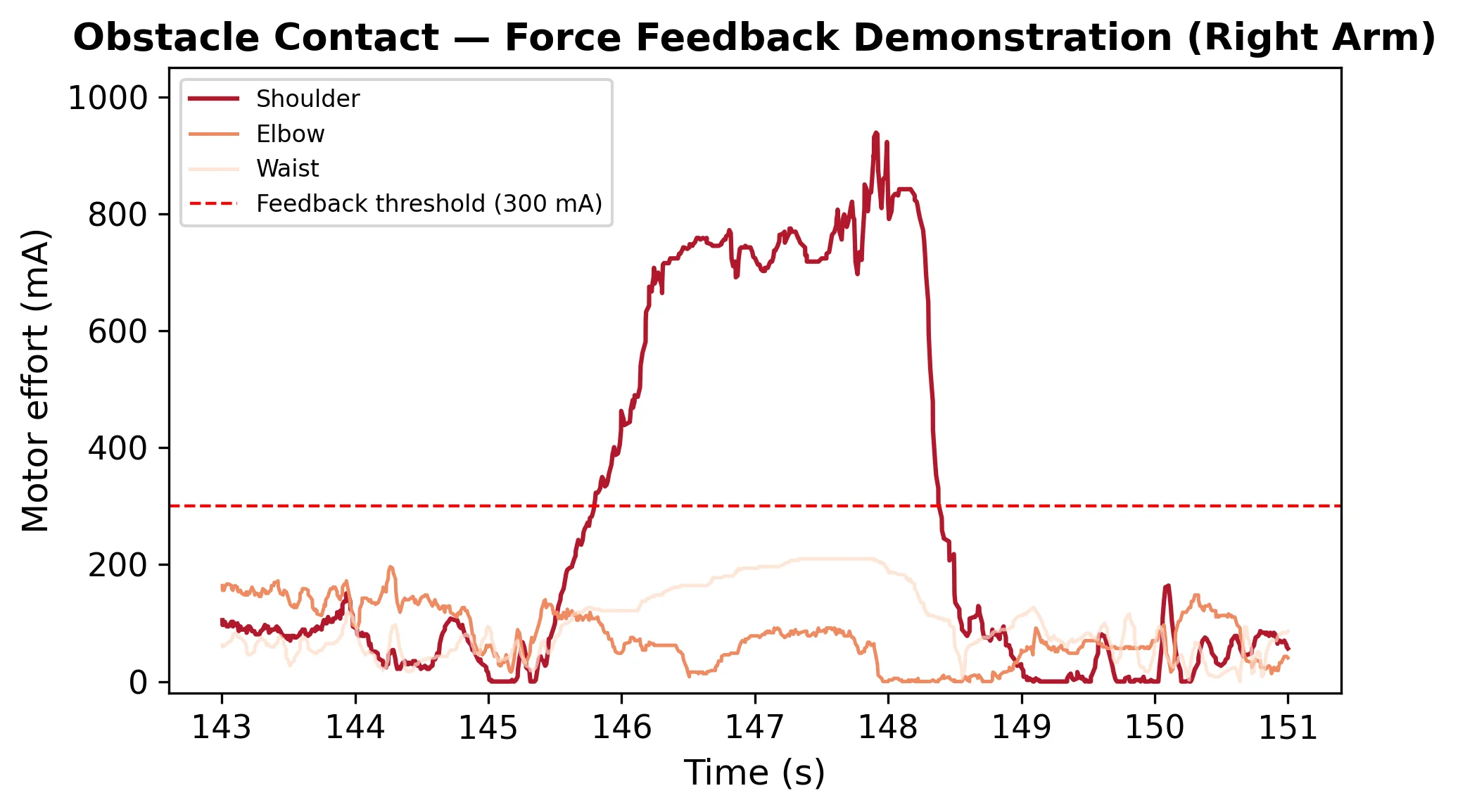
Effort graph showing obstacle contact: shoulder effort exceeds 300 mA threshold during contact
User Study
22 participants with no prior teleoperation experience evaluated the system. Key findings:
91.1%
Obstacle detection sensitivity
85.7%
Overall accuracy
6/14
Perfect accuracy participants
The biggest usability bottleneck was gripper ergonomics (10/22 mentions)—a hardware gearbox limitation, not a software issue. Force feedback was rated positively, with gravity confusion being the only systematic source of error.
Comparison
| System | Cost | Bilateral | Bimanual | Custom |
|---|---|---|---|---|
| ALOHA | ~$20k | No | Yes | Leaders |
| GELLO | <$1k | No | Yes | Leaders |
| Koch | $250 | No | No | Both |
| Echo | — | Yes | No | — |
| Ours | ~$3k | Yes | Yes | Followers |
Software
Built on ROS 2 Humble with 20 nodes across 4 arm namespaces. The system includes collision avoidance (invisible wall at workspace centreline), graceful shutdown (POSIX signal masking so heavy arms don't crash), smooth startup (gradual position ramp over 1.5s), and shared autonomy via RViz interactive markers.
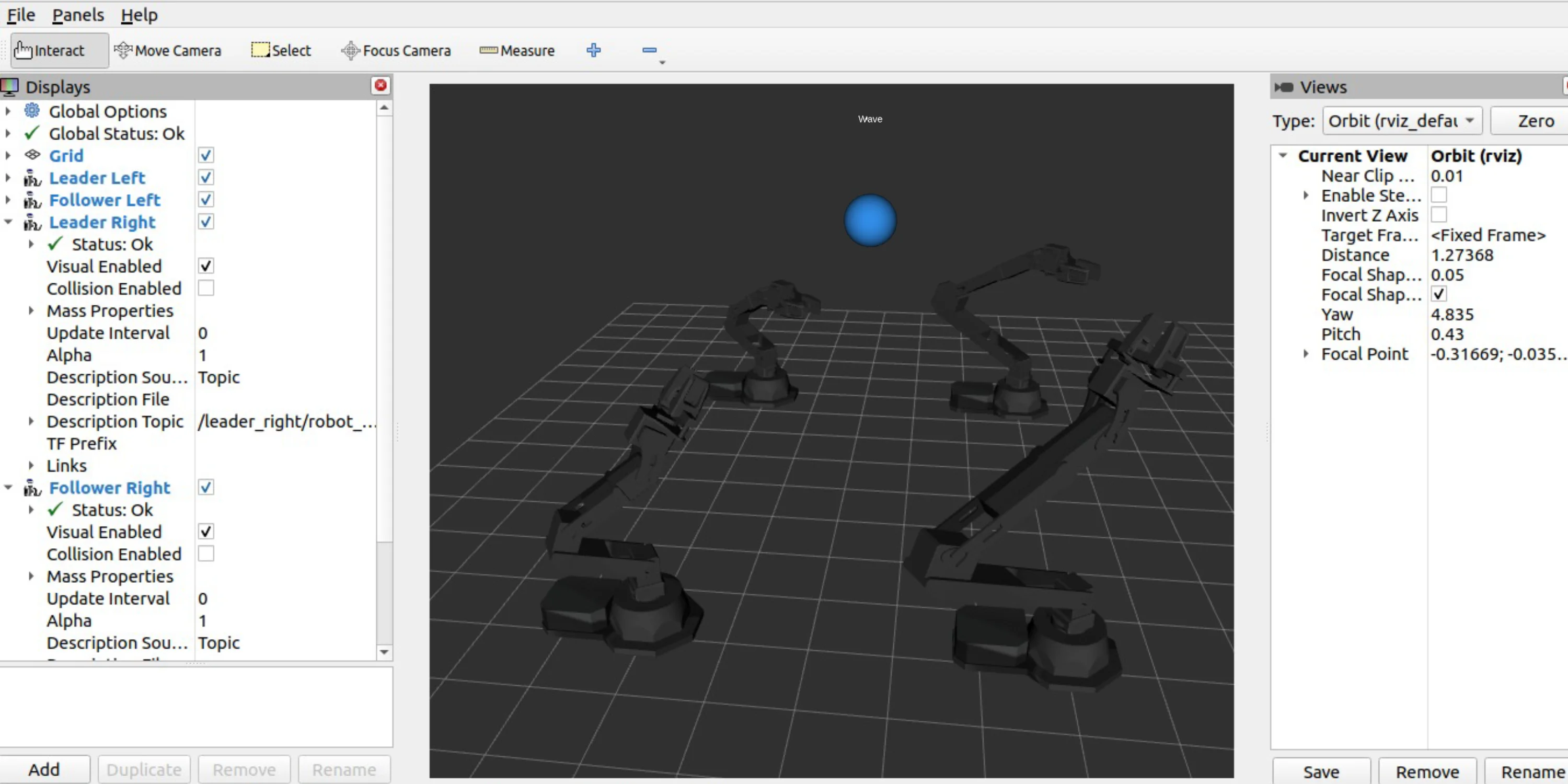
RViz visualisation showing all four arms with TF frames, effort displays, and collision boundaries
BibTeX
@article{camacho2026sensorless,
  title={Sensorless Bilateral Force Feedback
         for Low-Cost Scaled Teleoperation},
  author={Camacho Pel\'aez, Leonardo},
  institution={University of Edinburgh},
  year={2026}
}